**AI literacy:** what is expected from organizations?
More and more employees are using AI in their work. From ChatGPT and Copilot to smart AI features within existing software. This often makes work faster and more efficient, but it also brings new responsibilities.
That’s why AI literacy plays an increasingly important role within organizations. Since February 2, 2025, organizations that use or develop AI must ensure that employees have sufficient knowledge and skills to use AI responsibly.
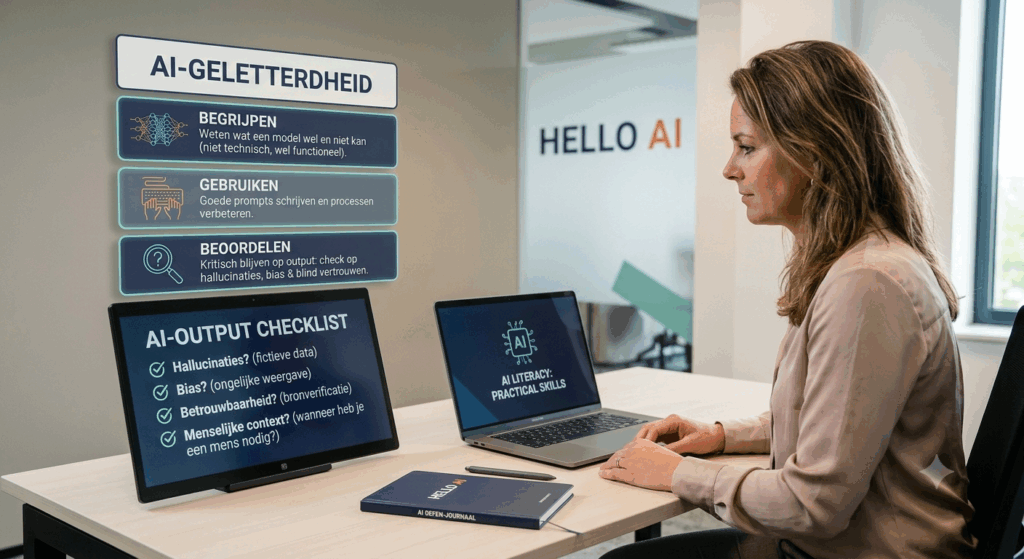
AI literacy is the fundamental skill of understanding, using and evaluating AI. It’s not about coding or having a technical background, but about knowing what a language model can and can’t do, how to write a good prompt, and where the pitfalls lie, such as hallucinations, bias or misplaced trust in an answer.
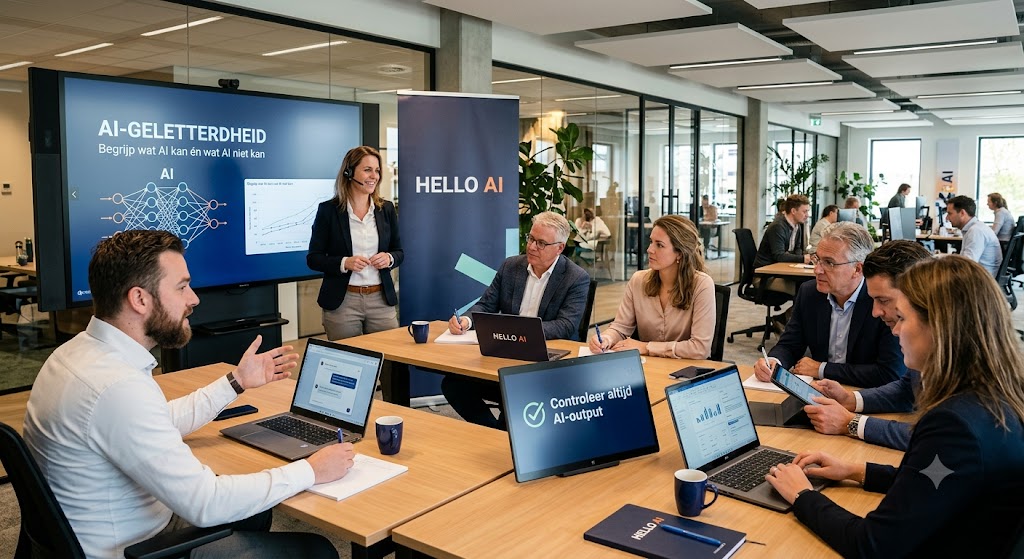
For businesses, it means employees deploy AI smartly in their own work: writing faster, summarising data, sharpening ideas, without blindly trusting the outcome. So you also learn to stay critical, check output and understand when you need a human instead of a model.
It’s a skill you build up, not a switch you flip. Someone who starts today will be noticeably more self-reliant in using AI within a few months, provided they practise with real cases from their own work.
AI literacy means that employees understand:
what information may and may not be shared with AI systems
what AI can and cannot do
how AI outcomes should be evaluated
what risks AI brings with it
So it’s not just about using AI, but above all about using it responsibly.
What does AI literacy cover?
AI literacy goes beyond simply learning how to use an AI tool. It’s about developing the knowledge and skills needed to use AI safely, effectively and responsibly.
Topics that are often covered include:
Basic concepts and how AI works.
Applications of AI in daily tasks.
Writing effective prompts.
Assessing AI outputs for reliability and quality.
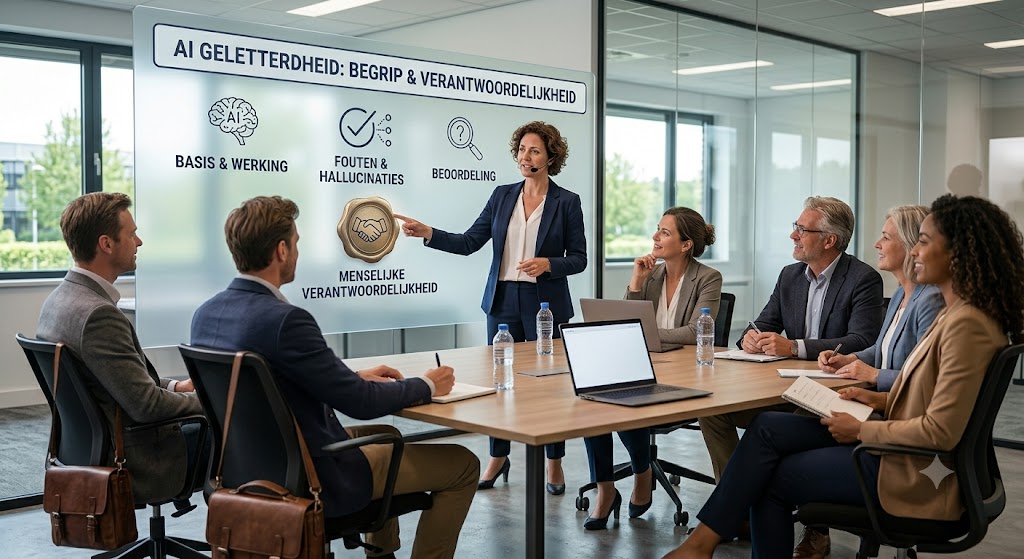
Recognising errors, biases and hallucinations.
Handling personal data and confidential information safely.
The opportunities, risks and limitations of AI.
The responsibilities of employees and organisations.
This way, employees not only learn how AI works, but above all how they can use AI consciously within their own role.
Why is AI literacy so important?
AI can take a lot of work off your hands, but it remains a tool. The AI systems that organizations use can make mistakes, misinterpret information, or generate answers that sound convincing but aren’t correct. This is precisely why it’s important that people keep thinking for themselves and approach AI with a critical eye.
A common misconception is that a mistake made by AI is also AI’s responsibility. That’s not the case. When an employee shares confidential data with an AI tool, adopts incorrect information, or bases an important decision on faulty AI output, the responsibility ultimately lies with the human and the organization.
What does this mean in practice?
For many organisations, AI literacy is still a relatively new topic. Employees often already use AI tools on a daily basis, but clear agreements, knowledge and awareness are frequently lacking. Employees gain insight into how AI works, what risks are involved, and how AI can be used responsibly in their daily work.
At Hello AI, we help organisations build this knowledge in a practical way. Not with technical theory, but with training that aligns with the daily practice of employees.
AI literacy training from Hello AI
Many organisations have already started with AI. The next step is to ensure that employees also truly understand the technology. Because ultimately, it’s not the tool that determines how successfully AI is used. It’s the people who actually work with it.
The training aligns with employees’ daily work, so that the knowledge gained can be applied directly in practice. This not only builds more confidence in the use of AI, but also gives organisations more grip on how AI is used within the organisation.
Do you want your company to work smarter with AI? Then follow one of our training courses!