AI sounds convincing. That’s what makes it dangerous. Because convincing isn’t the same as true. Discover what AI hallucinations are, how to recognize them, and why they can cost you dearly.
You’re sitting behind your laptop with a deadline that’s dangerously close. You open ChatGPT, type in your question, and within seconds a good piece of text appears on your screen. It looks professional, sounds convincing, exactly what you need. You copy the text and send it to your team or client. Done. But then something annoying happens.
You want to check your quarterly figures. You enter your revenue and ask ChatGPT for your growth percentage. “Your growth is 47% compared to last quarter,” the AI replies instantly. So you ask further: “When will I reach my annual target?” ChatGPT calculates further: “With this growth, you’ll reach your target in September, with a revenue of €340,000.”
You turn it into a presentation. Share the figures with your team. Until someone checks the math: your growth isn’t 47%, but 23%. That annual target? Not even close. Your whole story consists of made-up numbers. This is the danger of AI hallucinations. One wrong calculation, and the AI just keeps building on it. It sounds logical, but it’s not correct.
AI can lie. Not on purpose, but it happens. And those lies can be costly for your business or your credibility. The problem? AI sounds so convincing that we forget: convincing isn’t the same as true.
What exactly are AI hallucinations?
AI hallucinations are moments when AI “invents” information that isn’t correct. It seems logical, sounds convincing, and is presented with confidence. But it’s completely wrong.
Here’s the problem: AI predicts what should come next based on patterns in the data it was trained on. It doesn’t really “know” anything, it guesses which words are most logical in a given context. Just like your phone predicts the next word, but far more advanced.
Most of the time, this works well. But sometimes it misses the mark completely. And because AI has no sense of truth or lies, it presents incorrect information with the same confidence as correct facts.
This happens in practice
ChatGPT cheerfully claiming there are 15 months in a year. AI awarding fictitious accolades to companies. Fake statistics presented as facts. Lawyers getting into trouble because AI invented complete court cases, including case numbers and rulings.
We see companies stumbling over incorrect calculations in financial reports, inaccurate product specifications in webshops, and completely fabricated customer testimonials in marketing materials. These are not theoretical risks, this really happens.
Recognize the red flags
How do you know when AI is hallucinating? Watch for these signals:
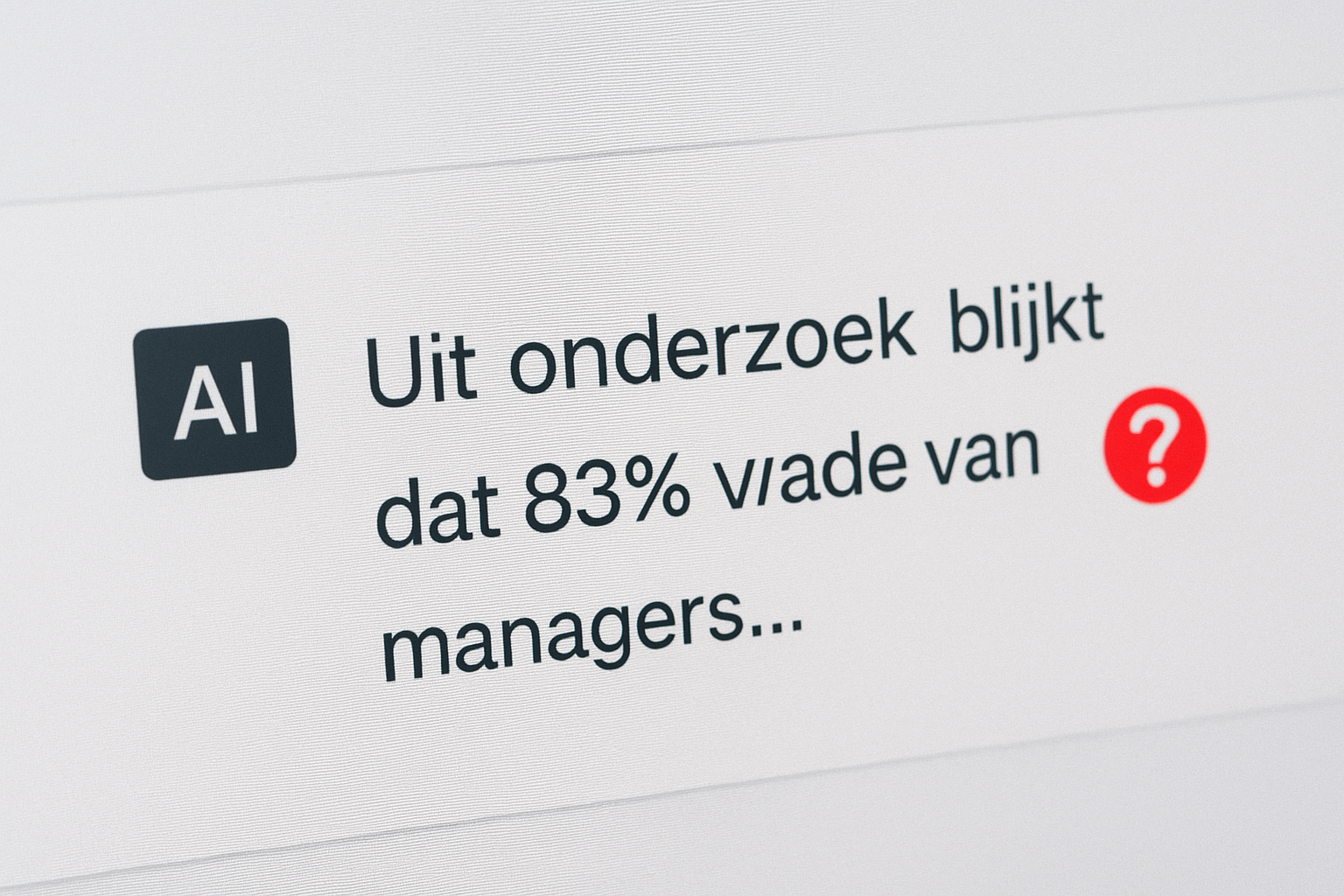
Specific figures without source attribution “research shows that 83% of managers…” but which research?
“Facts” that fit your situation too perfectly a case study that’s precisely about your niche industry? Check whether it actually exists.
Contradictions within the same conversation AI that states A in one paragraph and the opposite three paragraphs later.
Claims about recent events AI models are trained up to a certain date. Anything after that is guesswork.
Statistics that seem too good to be true exactly the figure you needed? Verify it twice.
Stay in control
You don’t need to distrust AI, but do stay alert. It’s about knowing how to work with it. Use AI output like Wikipedia: handy as a starting point, but not as an endpoint.
Ask for the source citation and look it up. Test answers against your own knowledge. If AI says something about your field that doesn’t match your experience, don’t simply dismiss it. Trust your expertise.
Use AI as a starting point, not an endpoint. AI is fantastic for brainstorming, first drafts and inspiration. But important content should always be refined, checked and personalized. Have crucial output reviewed by a human, especially with legal texts, financial data or medical information.
AI hallucinations aren’t a bug that disappears with the next software update. It’s fundamentally part of how these systems work. They generate text based on patterns, not on real knowledge or understanding. Does this mean AI is useless? Absolutely not. But it does mean you need to stay critical.
These systems are getting better. Hallucinations are becoming less frequent. But the risk never disappears entirely. As long as AI generates text based on predictions, there remains a chance that it goes in the wrong direction.
Prepare your team
AI is a powerful tool, but not a replacement for a search engine or database. It doesn’t know everything and makes mistakes. See it as support for your own knowledge and critical thinking, not as a replacement for it. Train your team to recognize red flags. Make clear agreements about when to use AI and when not to. Create a culture that balances AI with real knowledge. Because the best defense against AI hallucinations? A well-trained, critical and confident team that knows exactly how to use this technology smartly.
Do you want to learnhow to use AI reliably?
Our trainings teach your team to recognize and prevent AI hallucinations. Practical, with real examples from your own industry and concrete tools you can apply right away.